Tuesday, December 31, 2019

U.S. Blames Iran For Orchestrating Baghdad Embassy Attack


Trump blames Iran for ‘orchestrating’ Baghdad embassy attack


The Times of Israel is liveblogging Tuesday’s events as they happen.


Trump blames Iran for ‘orchestrating’ Baghdad embassy attack

US President Donald Trump blames Iran for Iraqi Shiite militia attacks on US interests, and the current attack by militia supporters against the US Embassy in Baghdad.
“Iran killed an American contractor, wounding many. We strongly responded, and always will. Now Iran is orchestrating an attack on the US Embassy in Iraq. They will be held fully responsible,” he says.
“In addition, we expect Iraq to use its forces to protect the Embassy, and so notified!”
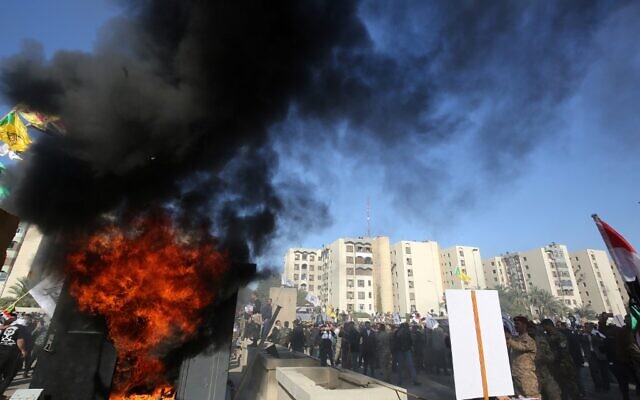
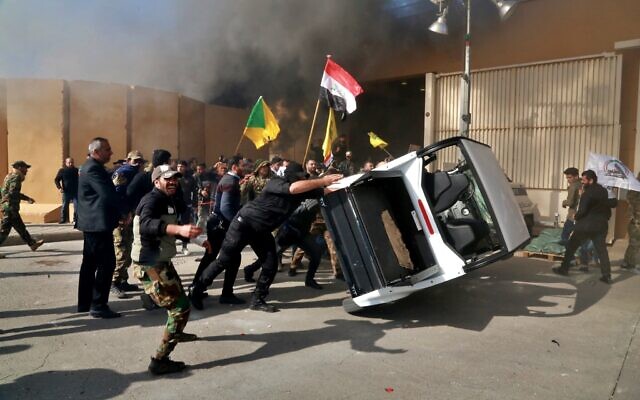
Dozens of angry Shiite militia supporters broke into the US Embassy compound in Baghdad today after smashing a main door and setting fire to a reception area, prompting tear gas and sounds of gunfire.
The embassy attack followed deadly US airstrikes on Sunday that killed 25 fighters of the Iran-backed militia in Iraq, the Kataeb Hezbollah. The US military said it was in retaliation for last week’s killing of an American contractor in a rocket attack on an Iraqi military base that it had blamed on the militia.


US President Donald Trump’s order for airstrikes on a Tehran-backed Iraqi militia group, after resisting retaliating against Iran for months, sent a clear message Sunday that killing Americans was his red line.
But experts warned that, far from being deterred, Iran might find that line signals there is space for them to continue the kind of provocative activities that fired up tensions across the Gulf region throughout 2019.
And with Trump facing a re-election fight in 2020, some said Tehran could even step up its actions to challenge the president’s promise to pull US troops out of the Middle East.
US officials said Monday that Trump had exercised “strategic patience” during the past year in the face of Iran’s stepped-up military activities in the region challenging the US and its allies.
But they said that the death Friday of a US civilian contractor in Kirkuk in a rocket attack by Kateb Hezbollah, or the Hezbollah Brigades, an Iran-supported militia, forced Trump’s hand.
At least 25 members of the group were killed in retaliatory US strikes Sunday on five of their bases in Iraq and Syria.
“The president has shown a lot of restraint,” Brian Hook, the State Department’s Special Representative for Iran, told reporters Monday.
“We very much hoped that Iran would not miscalculate and confuse our restraint for weakness. But after so many attacks, it was important for the president to direct our armed forces to respond in a way that the Iranian regime will understand.”
Trump mulled and then deferred retaliation against Iran several times this year over its attacks on foreign oil tankers, the downing of a US drone and the brash September drone-and-missile assault on oil plants in Saudi Arabia, which took out nearly half of Riyadh’s oil output.
Each time, the US leader fell back on more economic sanctions, despite them having had little visible impact on Tehran’s expansive regional military operations.
Since October, the Hezbollah Brigades, which the Pentagon said are supported by the Iranian Revolutionary Guard Corps, carried out some 11 rocket attacks on installations in Iraq where US and coalition forces are present.

Iraqi Supporters Of Iran-Backed Militia Break Into U.S. Embassy


Iraqi supporters of Iran-backed militia break into US embassy in Baghdad


 Dozens of angry Iraqi Shiite militia supporters broke into the US Embassy compound in Baghdad on Tuesday after smashing a main door and setting fire to a reception area, prompting tear gas and sounds of gunfire.
An Associated Press reporter at the scene saw flames rising from inside the compound and at least three US soldiers on the roof of the main building. There was a fire at the reception area near the parking lot of the compound but it was unclear what had caused it. A man on a loudspeaker urged the mob not to enter the compound, saying: “The message was delivered.”
The embassy attack followed deadly US airstrikes on Sunday that killed 25 fighters of the Iran-backed militia in Iraq, the Kataeb Hezbollah. The US military said it was in retaliation for last week’s killing of an American contractor in a rocket attack on an Iraqi military base that it had blamed on the militia.
Iraqi protesters set ablaze a sentry box in front of the US embassy building in the capital Baghdad to protest against the weekend's airstrikes by US planes on several bases belonging to the Hezbollah Brigades, on December 31, 2019 (Ahmad AL-RUBAYE / AFP)
Dozens of protesters pushed into the compound after smashing the gate used by cars to enter the embassy. The protesters, many in militia uniform, stopped in a corridor after about 5 meters (16 feet), and were only about 200 meters away from the main building. Half a dozen US soldiers were seen on the roof of the main building, their guns were pointed at the protesters.


Smoke from the tear gas rose in the area, and at least three of the protesters appeared to have difficulty breathing. It wasn’t immediately known whether the embassy staff had remained inside the main building.
The protesters hung a poster on the wall: “America is an aggressor.”
Earlier, the mob shouted “Down, down USA!” as the crowd tried to push inside the embassy grounds, hurling water and stones over its walls. They raised yellow militia flags and taunted the embassy’s security staff, who remained behind the glass windows in the gates’ reception area, and also sprayed graffiti on the wall and windows. The graffiti, in red in support of the Kataeb Hezbollah, read: “Closed in the name of the resistance.”
Also, hundreds of angry protesters set up tents outside the embassy. As tempers rose, the mob set fire to three trailers used by security guards along the embassy wall. No one was immediately reported hurt in the rampage and security staff had withdrawn to inside the embassy earlier, soon after protesters gathered outside.
Seven armored vehicles with about 30 Iraqi soldiers arrived near the embassy hours after the violence erupted, deploying near the embassy walls but not close to the breached area.
Tuesday’s embassy storming took place after mourners and supporters held funerals for the militia fighters killed in a Baghdad neighborhood, after which they marched on to the heavily fortified Green Zone and kept walking till they reached the sprawling US Embassy there.
AP journalists saw the crowd as they tried to scale the walls of the embassy in what appeared to be an attempt to storm it, shouting “Down, down USA!” and “Death to America” and “Death to Israel.”

Monday, December 30, 2019

U.S. Sec Of State Pompeo And PM Netanyahu Speak Following U.S. Attacks In Iraq


Pompeo and Netanyahu speak following US attacks in Iraq


Elad Benari, 


US Secretary of State Mike Pompeo spoke on Monday with Prime Minister Binyamin Netanyahu, the State Department confirmed in a statement.

The conversation followed the US air strikesagainst the Kataib Hezbollah militia in Iraq, which came in response to the killing of a US civilian contractor in a rocket attack on an Iraqi military base.

“Secretary Pompeo and Prime Minister Netanyahu discussed US strikes in Syria and Iraq and the threat Iran presents to the region. The Secretary reiterated that the US will take decisive action to defend its citizens and their interests against Iranian threats,” the statement said.

Earlier on Monday, Netanyahu said he spoke with Pompeo and congratulated him on what he called "the important US action against Iran and its proxies in the region".

Top US officials declared on Sunday that the air strikes against Iranian-backed forces in Syria and Iraq were “successful”, and hinted that the US was preparing for future attacks on Iranian assets in the Middle East.


Aftermath Of U.S. Strikes Against Iranian-Backed Forces - Israel Must Be Careful


Ex-IDF intel chief: Now that US engaged Iran, Israel must be careful


Following Sunday's US airstrikes on Iranian-affiliated militias in Iraq, Israel must now be more careful about its own airstrikes in Iraq, former IDF intelligence chief Amos Yadlin tweeted on Monday.

Yadlin said that the US decision to directly engage Iran and its proxies with kinetic force was "the crossing of a rubicon" in which the US set down a red-line for Iran that it will respond with military force if the Islamic republic kills Americans.

This past weekend a missile attack from an Iran-affiliated militia killed a US contractor and wounded US soldiers at a base in Iraq.

Iranian-affiliated militias had launched missile attacks on US forces for several weeks, but this was the first attack in which an American was killed.


Until now, many Israeli officials had criticized the Trump administration for failing to use force to respond to Iran's shooting down of a US drone, to an Islamic republic attack on Saudi oil fields and to the missile attacks on US bases.

In contrast, Israel has carried out airstrikes on Iranian militias in Iraq for between several months to even a year.

Last week, IDF Chief-of-Staff Lt. Gen. Aviv Kochavi even discussed the attacks in a more public and detailed manner than ever before.

Yadlin's point was that Israel had more freedom of action in Iraq against Iranians as long as the US was not acting.

However, now that the US is taking action against Iran, Israel must be more careful about such airstrikes in Iraq and coordinate them more closely with the overall US strategy.


Yadlin noted the risk that Iraq could force US forces out of the country and that Israel does not want to be the cause of such a scenario.


Just days after IDF Chief of Staff Lt.-Gen. Aviv Kochavi lamented that Israel was going up against Iran alone, airstrikes rocked several locations belonging to Iranian-backed Kata’ib Hezbollah in Iraq and Syria, killing dozens.

The airstrikes, which came two days after a barrage of over 30 rockets were fired towards the K1 Iraqi military base in Kirkuk which killed a US civilian contractor and wounding dozens of Iraqi and American troops, were described by the Pentagon as “precision defensive strikes” against the group that "will degrade" the group's ability to carry out future attacks against coalition forces.


The rocket barrage and the subsequent retaliatory strikes in the area of Al-Qaim are the latest peak in tensions between Washington and Tehran. And might have negative effects on Israel, which has been carrying out a war-between-the wars campaign against Iranian entrenchment since 2013.

Situated in Iraq’s restive Anbar province on one side and Syria’ Deir Ezzor province, al-Qaim is an area which is under the control of pro-Iranian Shiite militias who are handled by Iran’s Revolutionary Guard Corps Quds force.

Only last week Israel’s top military chief publicly admitted to Israeli airstrikes in Iraq, stating that Iran’s Quds force is smuggling advanced weapons in the country on a monthly basis “and we can’t allow that.”

The first strike close to Iraq attributed to Israel was in June of last year near the town of Al-Bukamal, killing 22 members of a Shiite militia.  The next month several other blasts rocked Shiite militia warehouses and bases across the country.

Both Israel and the US have warned that Iran and its proxy militias are the biggest threats to peace in the region and hope to weaken Tehran's growing influence across the Middle East and the Persian Gulf.


Iran got away with their attacks, perhaps because there were no American fatalities-until Friday.
“The fact that the US has taken so long to respond to Iranian escalation, and only responded to the loss of life, risks communicating that America’s red line and bar for action against Iran-backed malign activity remains high,”Benham Ben Taleblu, a senior fellow at the Foundation for Defense of Democracies told The Jerusalem Post.

“American military power, even when judiciously and narrowly applied, can also signal that Washington can’t be written off permanently from the equation.”
According to Taleblu, while the target following these strikes remains America, “Iran has long engaged in cross-domain escalation, absorbing costs in one area while responding in another.”
And Israel, he added “will need to develop contingencies for what, where, and how Iran-backed militias will respond to these air-strikes.”
So have the rules of the game changed? Is Israel no longer alone in the ring against Iran and its proxy groups?


Rumors Of War: More Military Action Against Iran?


Will It Be War? US Airstrikes Hit Iran-Backed Militias As Pentagon Warns More Military Action Coming


A lot of people seem to have forgotten that we were literally on the brink of war with Iran earlier this year. Back in June, President Trump cancelled a major U.S. bombing mission against Iran at the last minute, and things seemed to settle down quite a bit since that time. But now tensions are rising once again. On Sunday, U.S. airstrikes targeted Iranian-backed militias in Iraq and Syria that U.S. officials believe have been behind recent rocket attacks against U.S. forces. Of course those Iranian-backed forces never would have launched such attacks in the first place if they did not have permission from Tehran itself.
The Iranians love to hide behind proxies, and for now the U.S. is only conducting airstrikes against those proxies. But at some point President Trump’s patience is likely to run out, and at that point we could start hitting Iran itself. 
Over the past six months, the U.S. has sent 14,000 more troops to the Middle East, and it is being reported that “the Pentagon is considering deploying additional forces to the region”. The drumbeats of war are starting to get louder again, and many believe that eventually one side is likely to push the other side a bit too far.

The attacks that we just witnessed were supposed to send a very strong message to Tehran. According to the Daily Mail, five separate targets were hit, and at least 19 people were killed…
US air strikes left 19 people dead in Iraq and Syria on Sunday in retaliation against an Iranian-backed militia group blamed for a rocket attack two days earlier that killed an American contractor.
F-15 Strike Eagles hit five targets associated with Kataib Hezbollah, the Iranian-sponsored Shiite militia group, said Defense Secretary Mark Esper.
These airstrikes were launched to directly retaliate for the casualties that U.S. forces suffered from a rocket attack on one of their bases in Iraq on Friday
Officials with the U.S.-led mission to defeat ISIS said Friday that a U.S. civilian contractor was killed and several American troops were wounded in a rocket attack targeting an Iraqi base in Kirkuk.
The attack, which occurred Friday around 7:20 p.m. local time in Iraq, also wounded several Iraqi personnel, officials with Operation Inherent Resolve told Military Times in an emailed statement.

But of course that attack was just the latest in a series of rocket attacks that have targeted U.S. forces lately
I am certainly not a fan of military conflict, but if I am sitting in the White House and someone keeps lobbing rockets at my troops I wouldn’t wait two months to hit them back.

As I noted earlier, these Iranian-backed militias wouldn’t be doing anything without approval from Tehran. If Trump really wants these rocket attacks to stop, Iranian leaders need to be sent a message that will be clear and unmistakable.


And it appears that U.S. officials may be starting to lean in that direction. In fact, Secretary of Defense Mark Esper told the press on Sunday that more military action “could be warranted”

Pompeo, Defense Secretary Mark Esper and General Mark Milley, chairman of the U.S. Joint Chiefs of Staff, appeared briefly in a club ballroom to comment on the airstrikes.
Esper termed the offensive “successful,” but said that Trump was informed that a further military response could be warranted.
Personally, I don’t know what the Iranians are thinking.
Perhaps they believe that if they use their proxies to make things uncomfortable enough for U.S. forces that Trump will eventually pull them out of the region.